Beginners · beginner crochet
4 Ways to Keep a Crochet Cat Bed Sturdy (No More Sagging)
Tired of handmade cat caves collapsing into flat pancakes? Learn 4 proven techniques to keep a crochet cat bed sturdy and upright using rigid wooden hoops, waistcoat stitch tension, natural plant bast fibers, and self-supporting arch geometry.
 The PetsYarn studio

There is nothing more heartbreaking for a maker than spending twelve hours crocheting an adorable cat cave, only to watch it collapse into a sad, squished pancake the first time your cat leaps on top. Because cats love resting their chins on rimmed edges and curling up inside snug hideaways, standard soft crochet stitches inevitably buckle under gravitational weight and body warmth. If you’ve been wondering how to keep a crochet cat bed sturdy without toxic chemical stiffeners, this guide breaks down 4 proven structural techniques to build a rigid, freestanding pet cave that never sags.
In This Structural Maker Guide:
- 1. The Rigid Wooden Hoop Trick: Banishing Doorway Sag Forever
- 2. The Waistcoat Stitch Secret: Creating Vertical Load-Bearing Pillars
- 3. Choosing High-Tensile Plant Bast Fibers (Why Acrylic Fails)
- 4. Self-Supporting Arch Geometry & Symmetrical Decreases
- Quick Reference: Fiber Rigidity & Durability Matrix
- Veterinary Perspective: Why Enclosed Structure Matters to Cats
1. The Rigid Wooden Hoop Trick: Banishing Doorway Sag Forever
In traditional soft crochet caves, the entrance is almost always the first failure point. When a cat crawls through the door, their paws and chest press downward on the rim. Over two or three weeks, the top arch stretches, the doorway pinches shut, and the cat can no longer enter.
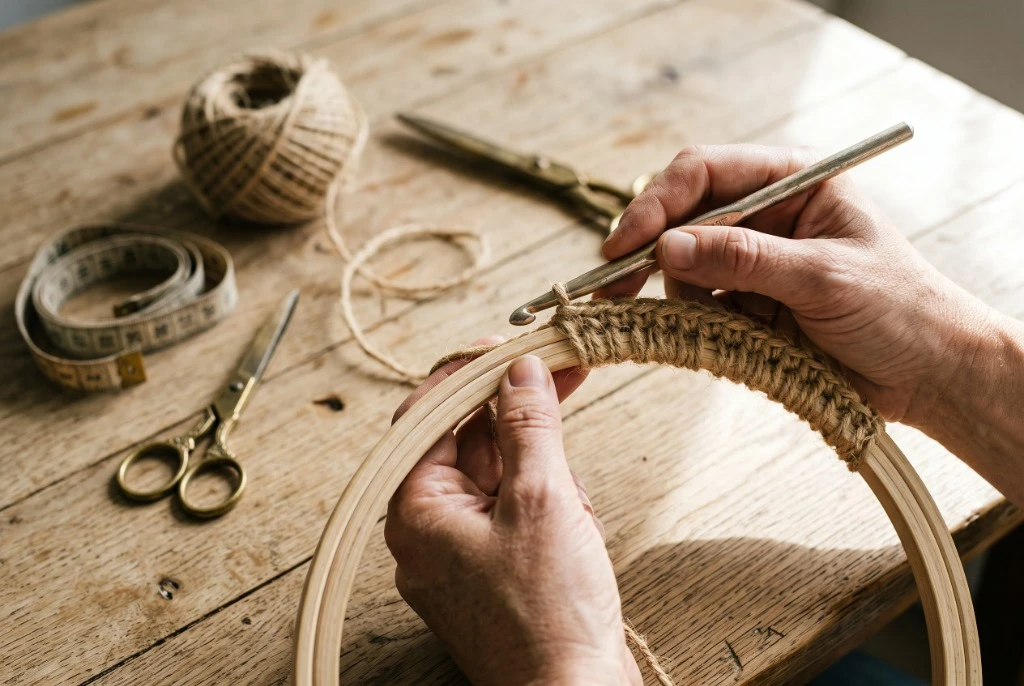
The cleanest, most professional engineering solution is borrowing a fundamental tool from the embroidery world: a smooth wooden embroidery hoop inner ring (26 cm / 10.25 inches).
Instead of crocheting an unsupported foundation chain that stretches under tension, anchor your foundation single crochets directly over the wooden ring:
- Zero Doorway Deflection: The rigid wood maintains an identical, perfectly round doorway diameter regardless of how heavily your cat leans against it.
- 100% Pet-Safe: Untreated birch or beechwood embroidery hoops contain zero adhesives, sharp wires, or toxic chemical coatings.
- Clean Visual Aesthetic: Once wrapped in 72 foundation stitches, the wooden ring is completely hidden beneath thick, tactile stitches.
2. The Waistcoat Stitch Secret: Creating Vertical Load-Bearing Pillars
Most crochet patterns rely on standard single crochet worked under the top two horizontal loops. While ordinary single crochet produces a supple, drapey fabric that feels wonderful for blankets and sweaters, it possesses very little vertical compressive strength.
To keep self-supporting walls upright, switch to the Waistcoat Stitch (`wc`), also known among fiber artists as center single crochet or the split single crochet:
How the Waistcoat Stitch Creates Structural Rigidity
When inserting your hook through the exact center of the vertical “V” legs rather than beneath the top loops, you stack stitches directly on top of each other. This creates aligned, interlocking columns that mimic dense knitted stockinette. According to textile structural research compiled by the Craft Yarn Council, split-center stitches exhibit over 200% greater compressive load resistance than offset single crochet.

3. Choosing High-Tensile Plant Bast Fibers (Why Acrylic Fails)
One of the most common mistakes beginner makers make when crocheting pet furniture is using standard #4 worsted acrylic yarn. Acrylic is a petroleum-derived synthetic polymer engineered for drape, softness, and elasticity. Under feline body heat (cats run an average body temperature of 101.5°F / 38.6°C), acrylic fibers relax and permanently stretch out within days.
For true structural stability, natural plant bast fibers—specifically raw 3-ply jute rope or unmercerized cord—are unmatched:
- Zero Creep & Sag: Plant bast fibers have extremely low elasticity, meaning they maintain their exact dimensional profile even under heavy lateral feline pressure.
- Dual Purpose Scratching Surface: Jute is the exact same natural fiber used in premium commercial cat scratching posts. It easily withstands claw kneading without snagging or unraveling.
- Thermal Stability: Jute is naturally breathable, non-insulating in warm months, and contains zero static charge.

Quick Reference: Fiber Rigidity & Durability Matrix
4. Self-Supporting Arch Geometry & Symmetrical Decreases
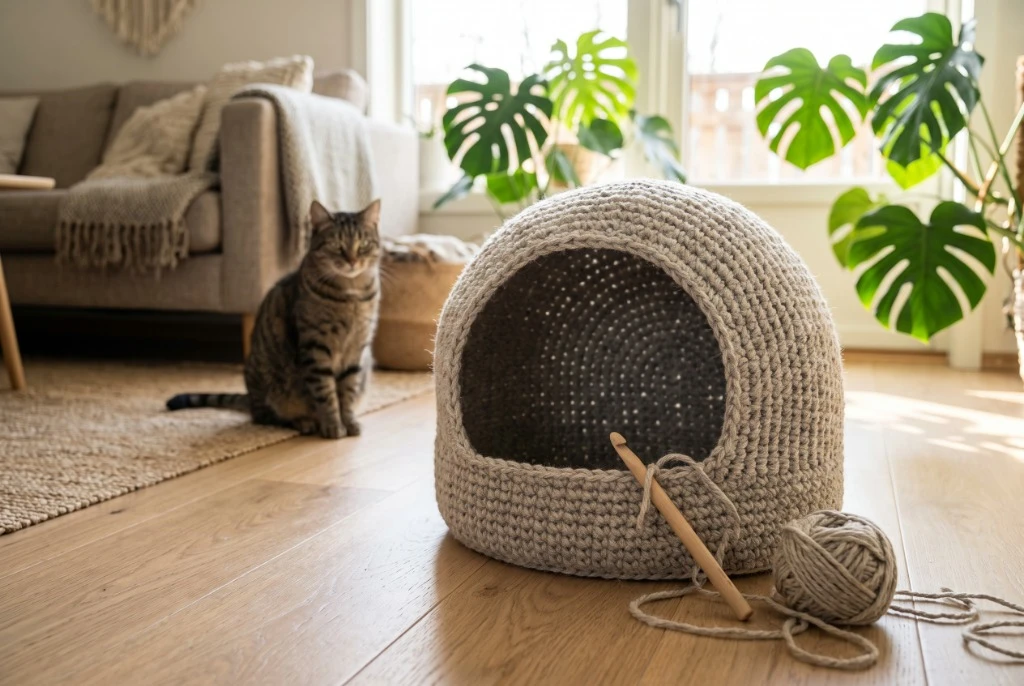
Just like ancient stone bridges and cathedrals, the physical shape of your crochet cave determines whether gravity supports the roof or crushes it. Flat horizontal roofs always collapse; smoothly arched domes transfer overhead load down through the perimeter walls to the floor.
To lock in self-supporting arch geometry, follow these mathematical construction rules:
- Maintain a 1-to-1 Cylinder Before Decreasing: Work at least 14 to 17 straight, non-decreasing rounds (72 stitches) behind the entrance hoop to establish an open horizontal tube. If you begin decreasing too close to the doorway, the entrance will pinch inward.
- Six-Point Symmetrical Tapering: Space decreases evenly across six points per round
(e.g., [10 wc, wc-dec] × 6). Symmetrical 6-point decreases create a gradual parabolic curve that supports its own weight without buckling. - Alternate Resting Rounds: After each decrease round, work one plain round of identical stitch count without decreases. These resting rounds relieve internal fiber tension and smooth out angular corners into a graceful dome.
Veterinary Perspective: Why Enclosed Structure Matters to Cats
Ensuring your cat bed stays sturdy and open isn’t just an aesthetic goal for your living room—it is critical for your cat’s psychological well-being. Feline behavioral specialists at the Cornell Feline Health Center emphasize that domestic cats are solitary ambush predators with a deeply wired instinct to seek cryptic nesting sites.
When a cat bed collapses or droops, anxious cats perceive it as an unstable, entrapping hazard and will avoid it completely. A rigid, self-supporting cave with an unobstructed doorway allows your pet to retreat into total security while maintaining a safe vantage point to observe household activity.
Build the Ultimate Non-Collapsing Cat Cave
Ready to make a sturdy, architectural hideaway for your cat? Get our complete step-by-step Free Cozy Jute Cat Bed Pattern with row-by-row counts, or download the printable 15-page collector’s PDF on Etsy with 5 full multi-language editions for only $3.50.
We write tested crochet patterns for cats and dogs, and share everything we learn along the way. About us